

Brooklyn, NY – May 7th 2026 –
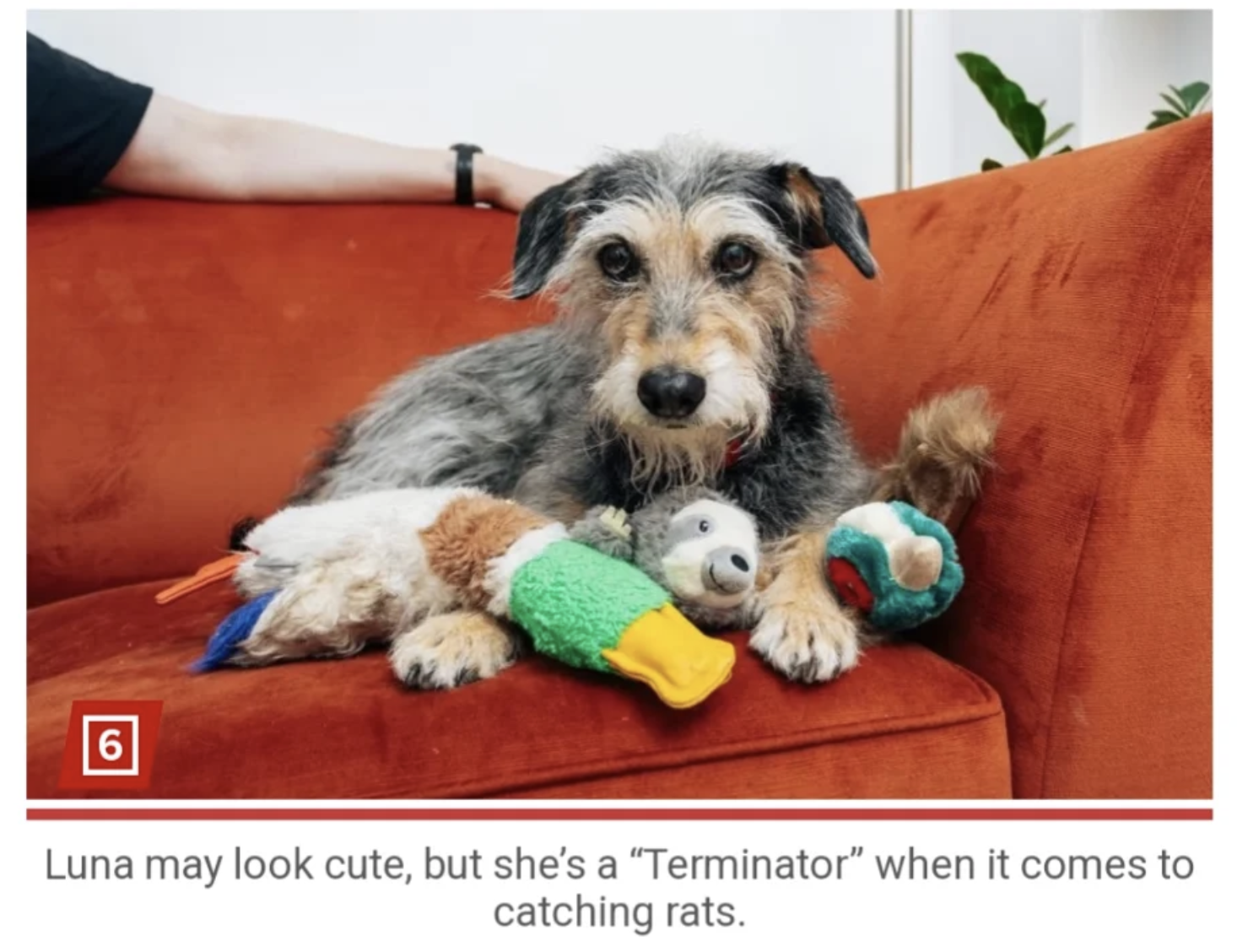
In a move that has stunned local residents, animal lovers, and the city’s growing underground community of rat-control enthusiasts, Luna — the scruffy Schnauzer-mix affectionately known across Brooklyn as the rat hunter — was reportedly taken into custody by city health officials late Wednesday night following concerns over possible hantavirus exposure.
The sudden seizure of the popular canine hunter has sparked outrage online and ignited a heated debate over public health policy, urban pest control, and the increasingly unusual role dogs are playing in New York City’s war against rats.
According to neighbors and sources familiar with the situation, officials from the New York City Department of Health and Mental Hygiene arrived at Luna’s owner’s Prospect Heights apartment shortly after 10 p.m on Wednesday, accompanied by officers from Animal Care and Control. Witnesses described a tense but orderly scene as Luna was escorted from the residence wearing a bright orange harness and placed into a city transport vehicle.
The operation reportedly followed an anonymous complaint alleging that Luna may have been exposed to rodents carrying hantavirus during a recent late-night hunt near the Gowanus Canal, an area long associated with heavy rat activity and ongoing environmental concerns.
For many Brooklyn residents, the idea that Luna could pose a public health threat seems almost impossible to believe.
The energetic terrier mix first gained widespread attention in 2024 after videos posted to Instagram account @lunasnoots began attracting millions of views. In grainy nighttime clips illuminated by flashlight beams and street lamps, Luna could be seen darting through alleyways, abandoned lots, and park underbrush with astonishing speed and precision. Her ability to locate and kill rats within seconds quickly turned her into something of a folk hero.
Within months, Luna had become a recognizable figure in neighborhoods across Brooklyn. Local shop owners offered her treats during walks, residents stopped to take selfies, and some fans even began referring to her as “Brooklyn’s smallest sanitation worker.”
Supporters claim Luna helped eliminate more than 300 rats over the past two years, though exact numbers have never been independently verified. Her owner, who has declined to be publicly identified since the incident, insists Luna’s hunts were always carefully supervised.
“She’s not some reckless attack dog,” the owner said during a brief phone interview Thursday morning. “She’s trained, vaccinated, healthy, and she never eats the rats. She does what terrier mixes were bred to do. People act like she’s dangerous, but honestly she’s probably done more for neighborhood sanitation than the city has.”
The Department of Health has released only limited details regarding the investigation, citing ongoing testing protocols. However, preliminary statements suggest that bloodwork conducted after Luna participated in a large-scale community rat hunt earlier this month revealed elevated antibodies consistent with possible hantavirus exposure.
Health officials emphasized that dogs are not known to develop symptomatic hantavirus infections in the same way humans do. Nor is there strong evidence that infected dogs commonly transmit the virus to people. Nevertheless, officials say Luna’s unusually frequent and direct contact with rats warranted immediate precautionary action.
“We take any potential rodent-borne pathogen seriously,” said Dr. Madeline DiLorenzo, an infectious disease specialist advising the city. “While canine transmission risk appears extremely low based on current research, this is still an evolving area of zoonotic disease management. Luna’s repeated exposure to large rodent populations placed her in a category that required intervention under current safety guidelines.”
The doctor added that Luna is being held at a secure veterinary quarantine facility where she is undergoing additional testing and observation.
“She is reportedly healthy, active, and behaving normally,” DiLorenzo said. “Our goal is not punishment. Our goal is caution.”
Public health experts note that hantavirus, though rare in the northeastern United States, can be extremely serious in humans. The virus is primarily spread through contact with infected rodent urine, droppings, or saliva, and severe cases can lead to life-threatening respiratory complications.
The controversy has also reignited broader conversations surrounding New York City’s worsening rat problem. Despite millions of dollars spent annually on extermination efforts, residents across all five boroughs continue to report increasing rodent sightings in subway stations, parks, dumpsters, and residential streets.
In recent years, informal “ratting teams” using terriers and other high-prey-drive dogs have become increasingly common in some neighborhoods. Advocates argue the practice offers an environmentally friendly alternative to poison-based extermination methods, which can unintentionally harm wildlife and pets.
Critics, however, warn that the hunts can expose dogs — and potentially their handlers — to dangerous bacteria, parasites, and rodent-borne diseases.
Animal welfare organizations have remained divided over Luna’s case. Some argue the city acted appropriately given the uncertainty surrounding exposure protocols, while others believe the seizure sets a troubling precedent for working dogs and urban pest-control animals.
As of Thursday evening, Luna remains under observation while confirmatory laboratory testing continues. Officials say the process could take several days or even weeks depending on the results.
If Luna ultimately tests positive for active infection markers, authorities say she could face extended quarantine restrictions or possible relocation under specialized wildlife monitoring protocols or even euthanization. If testing comes back negative, she may be released back to her owner with additional monitoring requirements.
Meanwhile, residents in Prospect Heights say the neighborhood already feels different without its tiny nighttime predator patrolling the alleys.
For now, Brooklyn’s most famous rat hunter waits behind quarantine doors as a city argues over whether she is a public health threat, an urban hero, or perhaps both at once.

